
‘It’s all on you’: Idaho families with disabled kids endure hardships without key program
BOISE, Idaho — It’s been over a year since Idaho ended a program that allowed parents and spouses to be paid for care they provided to their family members with disabilities. The Department of Health and Welfare terminated the Family Personal Care Services program in July 2025 after the agency said it found fraud and abuse, and didn’t have the staff or financial resources to administer it. ...
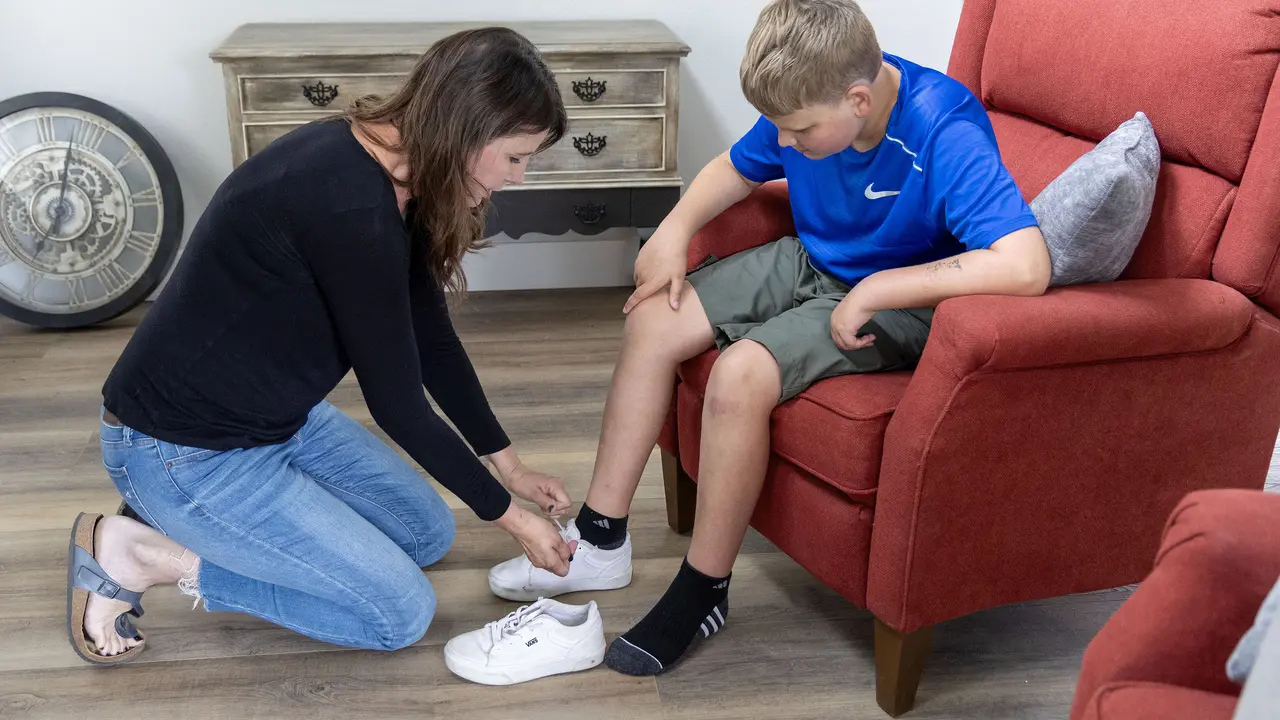
Shannon French helps her son Grady, 13, put on his shoes at their home in Meridian, Idaho.
Darin Oswald/Idaho Statesman/TNS
BOISE, Idaho — It’s been over a year since Idaho ended a program that allowed parents and spouses to be paid for care they provided to their family members with disabilities.
The Department of Health and Welfare terminated the Family Personal Care Services program in July 2025 after the agency said it found fraud and abuse, and didn’t have the staff or financial resources to administer it. Last session, lawmakers introduced a bill to bring the program back with guardrails, but it never received a hearing.
Families told the Idaho Statesman that in the year since the program ended, they have struggled to pay for housing and bills, have had to take on night jobs and side gigs to make ends meet and have seen negative impacts on their children. Some said they feel like they are costing the state even more money now, after signing up for government assistance programs or relying more heavily on care that is billed at a higher rate, such as in-home nursing. The added stress has made it even harder to care for their medically complex kids.
“How do I provide and be a mother and everything to my child when the one program that was finally giving me a sense of relief is now gone,” said Jessica Godsill, whose 9-year-old son has a rare condition and needs constant care. “We were just basically told: ‘These are your children. This is your responsibility. It’s all on you.’ “
Before the COVID-19 pandemic, parents and spouses were prohibited from being paid caregivers to their family members under federal and state Medicaid rules. During the pandemic, federal regulators allowed more flexibility for legally responsible adults to provide paid care for their family members.
The program was popular, and before it ended, hundreds of Idaho families took advantage.
Families who qualified for the program are still eligible for personal care services, but they must find outside caregivers — a known challenge in Idaho, which has a shortage of such workers. Personal care services can include help with bathing and dressing, toileting, eating and other essential activities.
Parents who spoke to the Statesman said they have struggled to find outside care. Some also said it’s hard to trust that others will be able to provide the care that their children need. Others have found a relative to help, but can’t fill all of their approved hours.
The shortage of direct care workers is a national problem, but Idaho’s situation is especially difficult, according to a 2023 report from the Idaho Office of Performance Evaluations. Idaho’s reimbursement rates for care providers also pale in comparison to some neighboring states.
In June, the Department of Health and Welfare told the Statesman that only about half of the nearly 900 people using the Family Personal Care Services program when it ended had direct care workers paid for by Medicaid.
Rep. Ilana Rubel, D-Boise, who sponsored the bill last session to restore the program, said she hopes to bring it back this year. The bill previously proposed had input from the Department of Health and Welfare, families who used the program and other stakeholders, she said, but the chair of the Health and Welfare committee did not hold a hearing for it as lawmakers searched for budget cuts.
“We just need to get the state to stop bankrupting itself with reckless revenue reductions and actually leave us with enough revenue to be able to provide basic services like this,” Rubel told the Statesman. "These families need it desperately. There’s no question in my mind about that, and we owe it to them. It’s unconscionable that we’re leaving these families in the lurch like this.”
Rubel said because the families are already qualified to have these services provided by a third party, the program should theoretically not cost the state much additional money. The fiscal note on last year’s bill said Idaho reimburses personal care services at about $24 per hour, but caregivers earn less due to other costs that rate must cover.
Idaho families are continuing to fight to get the program back ahead of the next legislative session.
These are five of their stories.
‘Haven’t been able to make ends meet’
Challis Hopwood’s son spent 110 days in the neonatal intensive care unit when he was born prematurely. Doctors thought he’d live for days. Today, Leon is almost 5.
Leon has quadriplegic cerebral palsy, skeletal dysplasia and microcephaly. He is nonverbal and can’t walk or hold his head up on his own, making him fully dependent on his wheelchair.
Hopwood learned about the FPCS program about a year before it ended, and enrolled. She qualified for 15 hours of care per week by the end of the program, she said. It doesn’t sound like much, but the extra money meant the family could pay their bills and put a little aside for Leon’s needs. At the time, they were trying to save for a wheelchair-accessible van.
“I have to do the job either way. Paid or unpaid, I’m still doing this job,” Hopwood told the Statesman. “Since the program ended, we haven’t been able to make ends meet.”
Hopwood’s husband works full time, but it’s difficult for the family to live on his salary alone, especially with their son’s needs. When the FPCS program ended, Hopwood said, their church stepped in to help them get an accessible van.
For a while, Hopwood was working a few side jobs. She ran a mobile petting zoo business, and would bring her son with her. But recently, she had to stop. Leon is sensitive to sunlight, and she couldn’t keep bringing him. She had no one who could care for him during that time.
“It just got to the point that I had to choose if I wanted to continue to be Leon’s mom or if I wanted to try and make ends meet with our finances,” she said. "I love him too much.”
The family lives in Sweet, about an hour from Boise, and haven’t been able to find any outside caregivers.
Hopwood said there was even a time when she wondered if she could continue to afford her son’s care. The family has been relying on government assistance programs, including the Supplemental Nutrition Assistance Program, sometimes referred to as food stamps, and Medicaid. They have also gotten loans from family members.
“I was raised conservative, so I wanted to be doing my part and being a taxpaying citizen,” she said. “And so when I was doing the FPCS program, I feel like I was able to be paid for the job that I’m doing, but still contribute to society, versus now, we’re on the welfare program, and I’m doing the same job, but not getting paid for it.”
She recently had to cancel a few of Leon’s therapies because she couldn’t afford the gas to get there.
Hopwood fought to keep the Family Personal Care Services program in place for her and other families, she said. She posted on social media to bring awareness and shared her story. She has seen comments from people who don’t understand why she would need to be paid to care for her child. But there’s so much more to it, she said.
“I have two other kids and they’re perfectly healthy, but Leon’s care is like four times as much as they are. We joke that he’s four kids in one,” she said.
“Nobody is exempt from being disabled,” she added.
She tries to make money here and there, such as through selling old clothing — anything where she can make a little pocket change.
But the expenses pile up. The family is still trying to get Leon’s bedroom adapted to fit his needs. They’ve been late on their mortgage a few months, and have then had to deal with late fees. She’s not sure how they’ll survive through the winter.
“There’s no light at the end of the tunnel. We’re never going to get out of debt,” she said. “It’s like we’re constantly living above our means because we can’t keep up with his therapies. Just losing the program was like getting the carpet yanked up from under us, and we fell on our butt.”
One month recently, Hopwood said, it looked like they wouldn’t be able to pay their power bill but she found a little extra money in her pants pocket. It was just the right amount.
‘Still not a workforce’
At the end of May, Trixy Wade’s daughter, Harper, 11, was in the hospital for over two weeks. She needed surgery for severe scoliosis.
Harper was born at 1.5 pounds and has brain damage that caused cerebral palsy and affected all of her limbs, Wade, who lives in Nampa, said. She can’t move on her own and is on continuous feeds into her jejunum, a part of her small intestine. She experiences seizures, scoliosis and other medical complexities.
When she got discharged, the hospital staff told Wade that Harper would need two people to care for her for the next few months. The surgery meant that she needed to be lifted and cared for in specific ways so as not to injure her. But Wade and her husband have been working opposite shifts since the FPCS program ended so someone is always home with Harper.
“We’d never been in a predicament where we needed two of us there, and I lost the one person that was always there when (my husband) had to go work nights,” Wade said. “So I’m just like, ‘Who do we depend on?’ ”
Wade said Harper’s grandparents helped out, but some of the care Harper needs requires lifting and moving her. Wade tried to find an outside caregiver to help when the program ended. She hasn’t been successful.
...