
Darren Waller knew he had more NFL life to live. It took one last transformation.
CHARLOTTE, N.C. — Darren Waller’s newest song isn’t up to date. It dropped on Aug. 28, and it’s been streaming-platform ready since July. But that’s not why it’s untethered to the life he’s living now. The song, called “Blindfolded,” was written two years ago, which is a long time in Waller years. Its cover art is a photo of Waller wearing a black hoodie with his tattooed hands covering his ...
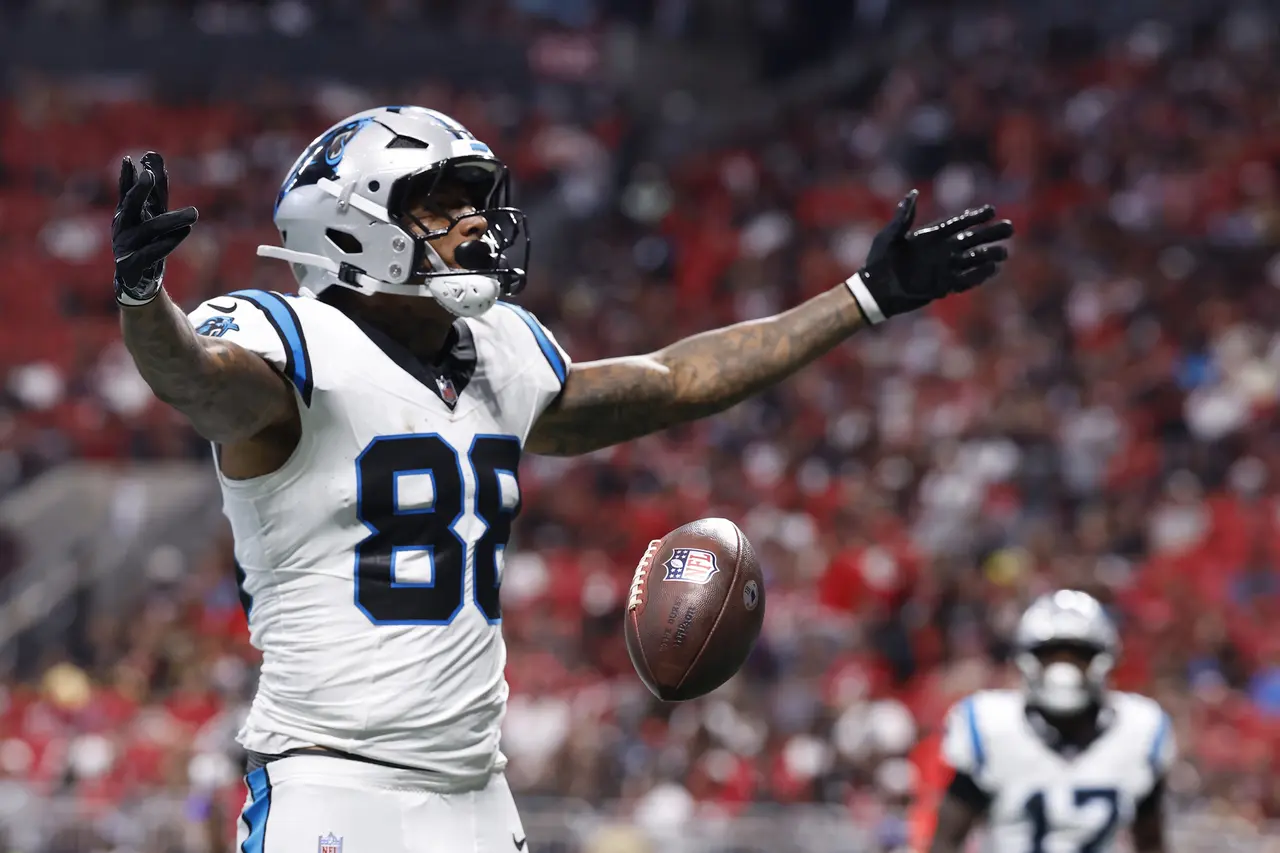
Darren Waller of the Carolina Panthers celebrates after scoring a touchdown against the Atlanta Falcons during the third quarter of the game at Mercedes-Benz Stadium on Sept. 20, 2026, in Atlanta.
Butch Dill/Getty Images North America/TNS
CHARLOTTE, N.C. — Darren Waller’s newest song isn’t up to date. It dropped on Aug. 28, and it’s been streaming-platform ready since July. But that’s not why it’s untethered to the life he’s living now.
The song, called “Blindfolded,” was written two years ago, which is a long time in Waller years. Its cover art is a photo of Waller wearing a black hoodie with his tattooed hands covering his face. The photo is completely upside down, too; the top of his head hovers at the bottom of the frame, in front of a blurry horizon. He sings in the chorus a cogent idea of looking back on a “time when I couldn’t see,” of watching the “shine in his soul” return. His verses, conversely, are scattered and ponderous. It sounds like he’s talking to himself, about himself, from somewhere else.
It’s almost as if he’s doing a thought exercise to see if anyone could begin to understand the decisions he’s made throughout his very public life, decisions that to the outside could feel transposed, upside down.
I thought they needed them to remember my name;
Until I’ve seen this brother walk away from the game;
I think I understand him now.
“It’s a snapshot of things I was experiencing while I was retiring,” Waller said of the song in an interview with The Charlotte Observer. The 6-foot-6, 245-pound, smiley but contemplative tight end said this on the Thursday prior to the Carolina Panthers’ statement win over the Detroit Lions in Bank of America Stadium — only a few weeks into a resurgent season for Waller that was unfathomable three months ago.
“So literally, in that line you talked about, I’m looking at myself, almost,” Waller continued. “I saw myself make the decision to leave. … Leaving the game is what allowed me to have experiences to bring me back to it. But you’re just kind of looking at snapshots of before, which isn’t necessarily in line with where I’m at now.”
Listening to the song today prompts the question: Where is Waller at now, anyway?
It’s a loaded query with a long story attached to its answer. Waller is one of the NFL’s few mythical figures — one whose story precedes his stats, whose name supersedes his acclaim. He is the Atlanta native and 2015 sixth-round NFL draft pick who nearly lost everything because of unaddressed addiction. In 2017, he was suspended by the NFL, went to rehab and emerged sober as a grocery store clerk. Twists of fate brought him back to the NFL, first as a practice squad player, then as one of the most dominant tight ends the league has ever seen.
Then came his decision to retire in 2023, a shock. Then came his rediscovery of music, something within him as far back as his great-grandfather and legendary jazz pianist and composer Fats Waller. Then came the rediscovery of himself — the rediscovery of peace.
That’s where “Blindfolded” ends. And if fate hadn’t intervened, that’s where his public life might’ve ended, too. But now, here Waller is: the starting tight end on a plucky 2-2 Panthers team with big dreams, third on the team in receptions (13) and receiving yards (148) and tied for the team lead in touchdown catches with two.
Instead of being the player who retired too young, he’s the monster playing old. He turned 34 in September, the day of the Panthers’ season opener. He’s the third-oldest player in the locker room — and the oldest of anyone by three years when you don’t count Carolina’s long-snapper and punter.
“I can just trace back over my career, and be like, ‘Anytime I’m absolutely certain the way things are gonna go, it’s like God or the universe throws a curveball in there,’ ” Waller said. He laughed and shrugged knowingly. “I don’t think anybody has had a journey through football like I have.”
And yet, just as you think you understand where he is — how he went from singing about post-football peace in 2024 to being on his second team in two years in 2026 — you learn about a final “curveball.”
You learn about this past offseason.
An offseason that required humility, consistency, belief without sight.
An offseason that began after a difficult 2025 — and a pair of phone calls.
‘I’m not going to reinvent the wheel’
Zaki Afzal and Taylor Barry had a simple message to Waller when the tight end reached out to them in January.
“I’m not going to reinvent the wheel,” Barry remembers telling his 6-foot-6, gazelle-striding friend. “I just need to reset the body.”
Those words were specifically Barry’s. But Afzal might as well have scripted them. Those are two of Waller’s close friends. Afzal is his physical therapist, in charge of managing Waller’s training load, his overall plan. Barry, the son of a Hall of Fame boxing coach, is a well-known trainer of athletes across sports and has spent the last several summers training over 200 players in the NFL.
They’ve each known Waller for six years.
And because of that, when they collaborated on their plan for Waller’s 2026 offseason, they knew it wasn’t going to be easy.
To understand why a “reset” was necessary, you’ll have to consider how Waller’s 2025 went.
There were parts that were successful, no doubt. Waller was out of the game completely in the summer of 2025 before the Miami Dolphins asked if he’d consider making his return to the NFL. When he was on the field, it was clear he could access the top of his game. He hauled in 24 passes for 283 yards and a tied-for-team-best six touchdowns. Advanced stats showed that he had a 62.5% “contested catch rate” and enabled a career-high 135.2 passer rating when targeted. That doesn’t begin to tell you how he impacted the game without the ball in his hands.
There were also parts that were not as successful — mainly the parts marred by his physical unreadiness. Waller only played nine games in 2025. He spent two stints on the Dolphins’ injured reserve list during the season — once for a pectoral injury and the other due to a hamstring injury. He also missed a bulk of training camp thanks to a hip injury in late August.
Waller wasn’t content after last season. His story with football wasn’t over, he said. That’s when he called Afzal and Barry.
“We’re going to get you right,” Barry told Waller. “Just trust our guidance and our process, and you’re going to be healthy all season.”
‘No trade secrets’ to Waller’s calloused body
The rest of the world saw Waller’s 2025 season as a statement of his age. Football is for gladiators; their only weakness is time.
But if you asked Waller and those in the know, there was more to the story.
Waller was doing a lot of HYROX training because that was how he wanted to spend his athletic capital in life after football. And while HYROX training is intense — it’s eight kilometers of running interspersed with intense lifting exercises — it’s not football. Far from it.
Such a change gave his trainers a lot of work to properly transform Waller into football shape — but it at least gave them an expansive blank canvas to do so.
“Honestly, there are no trade secrets,” Afzal told The Charlotte Observer, referring to this offseason. “I’ll tell you exactly what we were doing.”
Waller’s transformation required a holistic approach. For simplicity’s sake, there were three points of emphasis:
(1) Getting a deeper range of motion so his tissues can handle the stretches and twitchiness football requires. As Afzal explained, Waller is “a really high-force producer” — he “probably matches a small car in the amount of horsepower” he creates. And that’s great. But it also requires the tissues in the body to be fortified enough to yield those forces. Waller, thus, was directed to do a lot of split-squats. Lunges. Step-ups.
(2) Using isometrics to make sure his tendons adapt with the rest of his muscles. Tendons typically take longer to adapt to the rest of the body, “so we knew if we wanted his tendons to feel a good way, we’d have to have a progressing loading program, through the entire six months,” Afzal said. That meant a lot of exercises that required holding a position for long periods of time.
(3) Sprinting. A lot of sprinting. Almost all of Waller’s lower-body issues in 2025 were because of sprinting, his trainers said. “He just didn’t hit high intensity-like speeds enough times throughout the offseason” to be ready for football game speed, Afzal said. “We want to make sure, once we built up his body enough, to get those speeds that we want to so he would hit 90 percent to 100 percent effort sprint at least once a week, if not twice.” Waller was hitting max velocity regularly this summer — sometimes as fast as 23 miles per hour. He was frequently the first one at the top during hill-runs as he ran alongside athletes much younger than him under the Las Vegas sun.
“I know he wanted to play,” Barry said. “And this was by far the best version I’ve ever seen of him.”
All quiet on the NFL front
Still, while Waller made strides out of public view, the offseason was quiet. Uncomfortably so. It was quiet in February, when he started, right after the Super Bowl. It was quiet in March, the dawn of free agency. It was quiet in April, around the draft, and May and June and even July — when some teams, including the Carolina Panthers, began their training camps.
Silence from NFL teams was easier to stomach on days when he was surrounded by other NFL players. But when OTAs came and players went to their respective teams out of state, Waller was working out mostly in a quiet room.
“I would say there were moments when I was a little bit discouraged,” Waller said. “Just because, like I said, I wasn’t even looking to play for the Dolphins, and the opportunity presented itself. And then after that season, I’m committing right after the Super Bowl ends, I’m getting to work, and excited to see what happens in free agency.
“I could understand why teams would be a little hesitant and looking to mitigate risk when it came to me. But it was like, ‘Ah dang, I still have some stuff left in the tank to help a team out.’ ”
Afzal said he wished there was a better story he could offer — of Waller storming out of a workout one day and “saying oh, f— this,” and then having “this big triumphant moment we came through.” But everything about this offseason was process-based, process-oriented, he said. When Waller was low-energy in a workout, sometimes the two would just talk things through. There was a perfectly timed week-long trip to Iceland incorporated. When May turned to June and July, Barry stuck to a comforting refrain.
“Let’s just be consistent,” Barry said. “Let’s keep moving. Let’s set up a week-by-week plan. If you’re not signed by, say, Week 8, then, hey, let’s sit down. Let’s talk about how we adjust our training, kind of go more into a maintenance phase.”
Waller said that he was even willing to take a practice squad spot on team if that’s what was required.
“Yeah, I was completely open-minded,” Waller said. “Like I said, with the humbling part, it’s one thing to say it. It’s another thing to actually walk through it, when something could be even more humbling than you anticipated. I have active-roster and impact-playmaking ability, but that doesn’t necessarily mean that a team is ready to put me in that position yet. I placed myself out there, but I also have to meet them where they’re at in their situation. ... I have committed to going through this process, and sometimes this process has turns that you may not necessarily have anticipated.”
By the time the Panthers called, in late August, they were one of two teams to show interest in Waller. The other was the Dallas Cowboys, and they merely wanted to bring him in for a workout, Waller said. Conversely, when Carolina reached out, the team was ready to sign.
Cameras caught Waller in real-time learning that he’d been signed by Carolina. He was wearing jean shorts and an oversized T-shirt and a hat, filming part of an offseason documentary of sorts; he was ironically talking about navigating the uncertainties of this offseason — “football-shape is something I don’t think you can truly replicate … hold on … I’m gonna take this” — when he stood up and received the call.
He eventually hung up, shoved his phone in his pocket and tried to conceal a smile: “OK, it looks like the offseason is officially coming to an end.”
Waller’s choice to surrender knowing what’s next
Asking Waller about the offseason isn’t all that difficult now. He’s in a comfortable place. He’s healthy. The quiet moments of the offseason were eventually quelled by the madness of a young locker room, on a team replete with potential. It’s also not hard to find people to speak positively on Waller’s behalf.
That includes Panthers safety Tre’von Moehrig, who worked out with Barry and Waller this offseason. That includes quarterback Bryce Young, who’s having the type of season that’s eliciting “M-V-P!” type of cheers.
That also includes head coach Dave Canales, who on Tuesday went on a 60-second explanation of how valuable Waller has been, how much he impacts an opposing defense, how corners don’t know how fast he is, how Waller can allow the Panthers to be dangerous out of 12 personnel (one running back, two tight ends) when the opposing defense goes to their nickel packages. Canales added that “all those things are starting to materialize for us.”
The coach also added, with a hint of possibility: “I know there’s still more we can do.”
But Waller doesn’t mind admitting that an earlier version of himself — one that hadn’t already accomplished so much in the game, one that hadn’t done work on himself outside of it — probably wouldn’t have been able to withstand the journey toward this offseason’s delayed gratification.
“I don’t think I would’ve had the tools, or the experience of being like, ‘Man, something took a little longer than I expected it to,’ ” Waller said. “But it still came, and it felt rewarding because I was afraid or a little bit doubtful of how it would turn out. So once you have experiences like that, it allows you to approach things from a different perspective.”
Waller, after all, has seen how helpful it is for him to have what he calls “really humbling moments,” he said.
“Going to work at Sprouts Farmers Market is a humbling moment,” he said, referring to the time he was freshly out of rehab but still suspended from the league, stocking shelves at a grocery store. “Being inactive on the Baltimore Ravens and being reinstated and being on practice squad and watching two tight ends that they drafted because they couldn’t rely on me — that’s a humbling moment that ended up being very valuable.
“So I have these accolades, and I’m still working, and I used to be the guy, one of the faces of the team. And now it’s hard for me to get on a team. That’s a humbling moment too. But it’s like, ‘OK, that might sting a little bit.’
“But I look back to these past humbling moments, and those proved to be valuable for me. So let me at least keep an open mind on how this could be valuable for me on whatever’s next.”
‘Darren can play for two more years’
And what’s next, you ask?
“Darren’s the type of person who could play for two or three more years. I mean that so wholeheartedly,” Barry said.
I asked Waller if he contemplated the future, when his retirement for good might be. He laughed, as if I hadn’t been paying attention to his answers about process, about presence in moments, about enjoying a regular season that he once doubted would come at all.
“I haven’t put any numbers on it just because I feel like it’s so important for me to be present week to week, day to day,” Waller said. “I feel engaged and in it. I’m enjoying it. I’m enjoying competing. I feel like my body’s in a good place.
“I think I realized in my time away that there’s a lot of life to be lived. But last year showed me that I still got a lot more in the tank. There’s a lot more of that spark, that joy, that comes out in playing.”
He had to work for that joy, of course.
But that very work, he’d probably say, is what makes this joyful at all.