
Kevin Sherrington: So what if World Cup doesn't vault US into elite? It left a positive impression on us and our guests.
ARLINGTON, Texas — Not since the late 17th century has Texas yielded as much hallowed ground to France and Spain as it did Tuesday at JerryWorld, where the state's former landlords ruled again, at least for a day. Les Bleus and La Roja looked right at home in front of 70,106, which, given the USMNT's prospects going into the World Cup, was all the hosts could have realistically hoped. Only ...
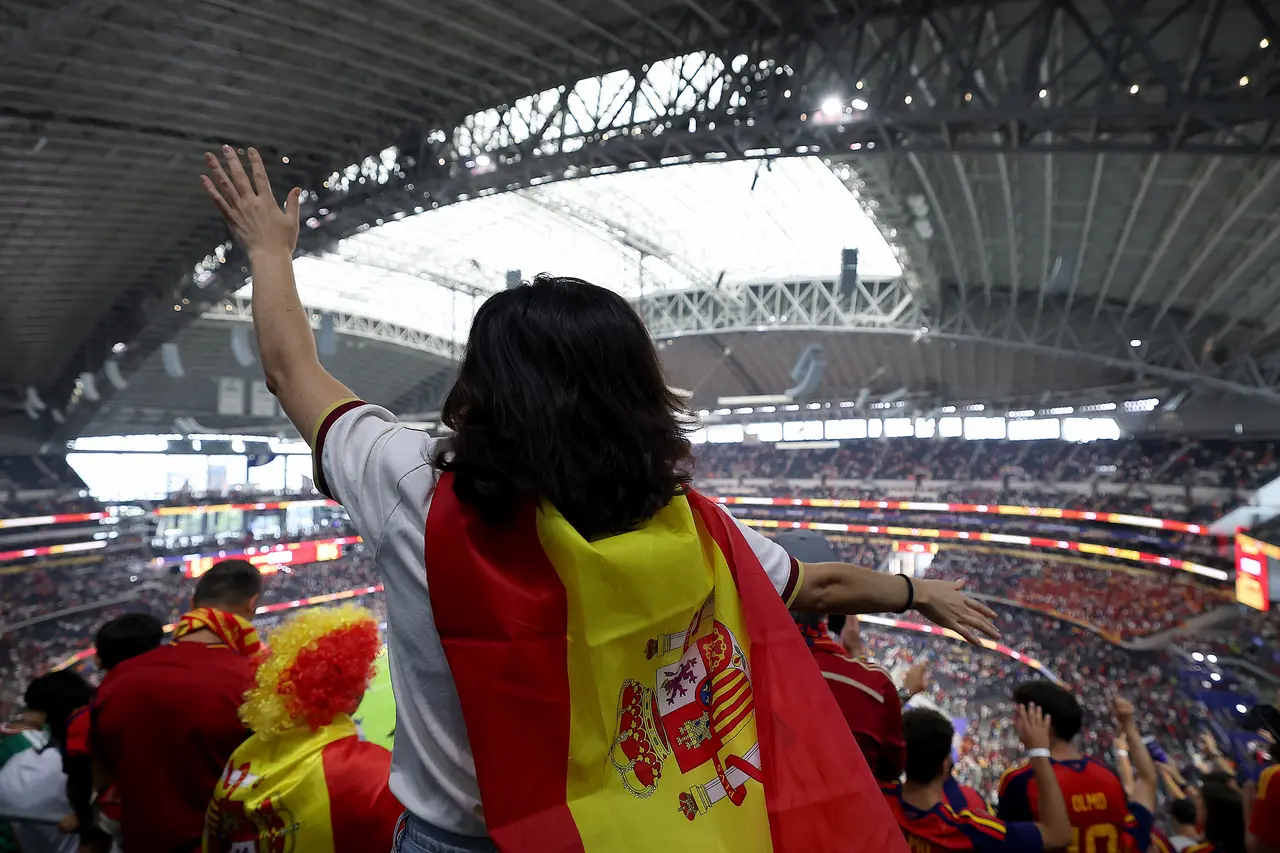
Fans of Spain celebrate the team's 2-0 victory in a World Cup semifinal against France on July 14, 2026, in Arlington, Texas.
Dustin Satloff/Rexona/Getty Images North America/TNS
ARLINGTON, Texas — Not since the late 17th century has Texas yielded as much hallowed ground to France and Spain as it did Tuesday at JerryWorld, where the state's former landlords ruled again, at least for a day. Les Bleus and La Roja looked right at home in front of 70,106, which, given the USMNT's prospects going into the World Cup, was all the hosts could have realistically hoped.
Only France could have asked for more, losing for the third time in three years to Spain, 2-0.
And on Bastille Day, no less.
Like getting stiffed at your birthday party.
"We did not find the key," the French manager, Didier Deschamps, said of the tournament's No. 1 team, "to unlock this potential."
Les Bleus have time on their hands to consider where it all went wrong in a dud of a final act in the World Cup. Spain, which had given up just one goal going into the semis, once again had an answer for everything.
The question now in the wake of North Texas' World Cup experience:
Who left the bigger impression on whom?
The hosts or the visitors?
Related: World Cup showed FIFA how 'we do things bigger and better in Texas,' Dallas organizer says
The anecdotal evidence is occasionally compelling. Erling Haaland, who vaulted from soccer icon to international superstar during the tournament, went back to Norway with several pairs of boots, a "Y'all can kiss my Dallas" T-shirt and a stuffed raccoon from Wild Bill's Western Wear, which, before you call, is reportedly all out of raccoons since it went viral.
If you were wondering, we rubbed off on the World Cup, too. Other than ticket prices and a certain red-card reversal, the scourge of the tournament had been the three-minute hydration break in each half. Truly devout soccer fans regard any stoppage in play just short of heresy.
But, with broadcast revenues flat across Europe, a few concessions may have to be made. The topic is under discussion, anyway. Especially after Fox reportedly made $250 million on ads during the breaks.
The creep of good ol' American capitalism into the beautiful game has been undeniable. Ten years ago, the World Cup reportedly received less than 10% of its media rights revenues from the U.S. Now it's closer to 25%. Expect that number to increase from here on out.
As for the World Cup's effect on the U.S., consider that the last time it was in North Texas, in '94, the buzz was so loud, you might have expected the the soccer on this side of the pond to grow alongside your new family.
Here it is, four adult children later, and I'm still waiting.
Oh, the U.S. started fast this World Cup, and it had its moments. But, since its ignominious exit at the feet of Belgium, a nation with the population of Ohio, critics have worked overtime on explanations. Some say it's a systemic issue, blaming moneyed youth programs that fail to reach a broader demographic. Probably simpler than even that.
Can a nation where soccer ranks behind the big four pro sports — not to mention college football — expect to provide enough elite athletes to compete with the world's best?
Going into the semifinals, The Athletic ranked the World Cup's top 50 players. Spain led with nine, followed by France (8), England (6) and Argentina (5). Norway, Belgium and Morocco tied with three apiece.
The U.S. had one, same as Senegal, Switzerland and the Ivory Coast.
By all accounts, Mauricio Pochettino, the latest in a long line of U.S. managers charged with the impossible task of co-opting Herb Brooks' "Miracle on Ice," did a bang-up job. Juiced up its offense. Created a team-first culture.
But, as Mike McCarthy would surely tell you, even a coach with a Lombardi Trophy on his mantel is only as good as his players.
One of these days the U.S. may, indeed, catch up with the world's best, but it won't be on my watch. Still, if we never do, would it really be so bad? Isn't it enough that we dominate most pro sports and hold our own at the Olympics? Do we have to kill it in everything?
Can't we grant the rest of the world sovereignty over a sport beloved above all others, as opposed to our fifth-favorite?
A little international esprit de corps seems fitting given the overall generosity of spirit. Some of us didn't see it coming. Frankly, I had visions of traffic jams and ticket scams and befuddled strangers asking which way to the subway. Confrontations. Complaints. Maybe something ugly. The closest we came was a dust-up between a Dallas cop and an Egyptian team member that was quickly smoothed over.
We heard story after story from visitors who were told to expect the worst. Yet, by their testimony, they seemed to catch us at our best.
"We owe America a huge apology," Englishman Oliver Henry said on TikTok during his visit to North Texas, "because America is nothing like what the media tells us. Everyone is so friendly. Everyone is so accommodating, and I've honestly had the best time."
Well, it wasn't all butterflies and rainbows. When Jerry Jones' mug turned up on the big screen, the reaction was mixed, at best.
Must have been some Cowboys fans on hand Tuesday.
Now France heads to Miami for the third-place game and Spain to New Jersey for Sunday's finale. As was the case more than 300 years ago, they left their mark here. Here's hoping they got as much out of it this time as we did, and that maybe someone ran 'em through Six Flags before they got away.
____