
John Romano: While a stadium awaits approval, a neighborhood waits for answers
TAMPA, Fla. — When it comes to building a $2.3 billion ballpark surrounded by a massive mixed-use development, there’s one question that applies to everyone but is rarely spoken aloud by anyone: What’s in it for me? For the Tampa Bay Rays, the answer is simple. A new ballpark leads to increased revenue, which leads to greater profits and an easier path to compete in the American League East. ...
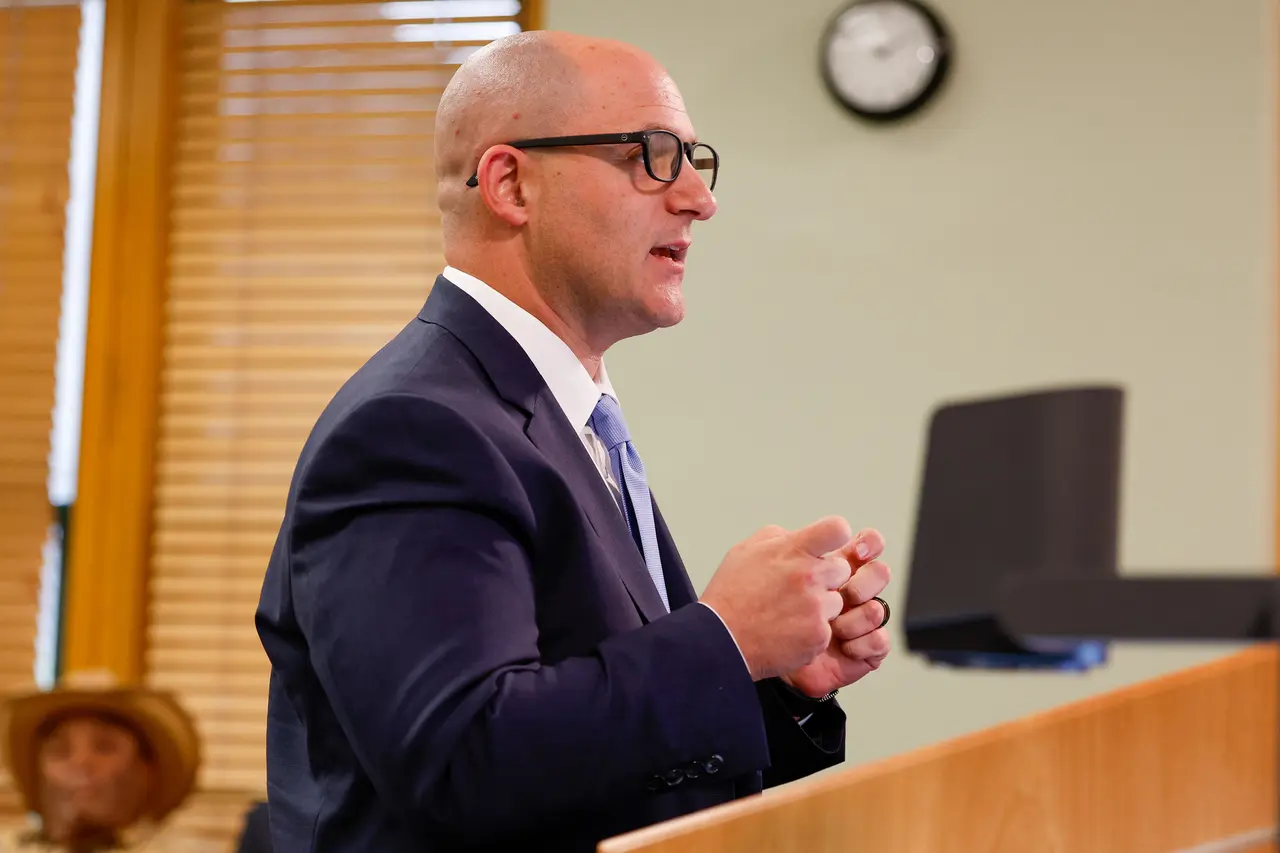
Tampa Bay Rays CEO Ken Babby, shown speaking to City Council members in May 2026 in Tampa, Florida, appeared at the Drew Park Community Advisory Committee meeting on June 10, 2026.
Jefferee Woo/Tampa Bay Times/TNS
TAMPA, Fla. — When it comes to building a $2.3 billion ballpark surrounded by a massive mixed-use development, there’s one question that applies to everyone but is rarely spoken aloud by anyone:
What’s in it for me?
For the Tampa Bay Rays, the answer is simple. A new ballpark leads to increased revenue, which leads to greater profits and an easier path to compete in the American League East. For baseball fans, it puts to rest the question of Major League Baseball’s uncertain future in Tampa Bay. For a handful of politicians, it’s having their name attached to a potentially transformational economic development. For a sports columnist, it’s the gift that keeps on giving.
And then there are the people of Drew Park — the businesses and homeowners most directly affected by the plan — who are worried their world is about to be upended.
What’s in it for them?
Nobody asked the question quite so directly at a Drew Park Community Advisory Committee (CAC) meeting on Wednesday night. Instead, it was broached in a variety of other ways. What about traffic? What about Hillsborough College? What about the neighborhood vibe? Most importantly, what about the $100 million from the Community Redevelopment Area (CRA) coffers that is designed to address poverty in the neighborhood but will instead be invested in the ballpark?
“That was one of my complaints, if you want to call it that, when I went to the CRA meeting a few weeks ago,” said Maritza Astorquiza, the chair of the Drew Park advisory committee. “No one has approached us, but people are making decisions with our money. How can you make decisions about people’s money — taxes in this case — that come out of their work, their sweat, their services, their products?
“You’re taking that, you’re applying it somewhere, and you’re not even telling us about it?”
For a project of this size, the Hillsborough College plan has come together rapidly. Nine months ago, few knew this land was even on the radar. It’s caught a lot of people by surprise, and even some stakeholders have been forced to play catch-up.
But for old-timers in Drew Park, these promises of ballparks and prosperity have been around forever.
Back to the future
The first vote by city officials was a 5-1 rejection of the stadium plan. The second was a 3-3 tie that was, essentially, the same outcome.
In a public meeting, the mayor’s idea was described as a scheme to force this “enormous project down your throats.” The plan to use taxes originally earmarked for infrastructure was deemed a violation of “the trust of the people” by one city official. Other critics said the city would go broke trying to come up with construction funds.
Yes, the deal to build football and baseball stadiums in 1949 looked all but dead until Mayor Curtis Hixon obtained an extension from the War Assets Administration that was in a hurry to unload the Drew Field property.
Working quickly, the mayor came up with a new financing plan to buy those 720 acres of land that had been used as a military airfield during World War II. Instead of taking tax money from a utilities fund as originally conceived, he proposed borrowing the $70,400 needed from an incinerator fund.
His plan, beyond acquiring the land, was to build a football stadium to compete with Miami and Jacksonville for college bowl games and to build a spring training ballpark to replace the makeshift stadium at Plant Field. The money would also purchase the Rocky Point Golf Course, which would turn into a municipal course, as well as building tennis courts and possibly a new campus for the University of Tampa.
Less than a week after the deadlocked 3-3 vote, Hixon had turned the tide. The city approved the plan by a 6-to-1 margin.
Eventually, that land purchase led to the construction of Al Lopez Field, which became a spring training site used by the Chicago White Sox and Cincinnati Reds for more than 30 years and was home to the Class A Tampa Tarpons. Tampa Stadium went up a decade later and was home to the University of Tampa’s football team before the Buccaneers took over in 1976. The Rocky Point Golf Course was remade and, while UT did not move in, a campus was built for what was then called Hillsborough Junior College in 1968.
Nearly everything Mayor Hixon promised came to pass.
Except for the revitalization of what became the Drew Park community.
In 2004, it was officially designated as a blighted area.
Is Drew Park a perfect fit?
It’s more industrial park than traditional neighborhood. An airport-adjacent community with “aging and inadequate infrastructure, an obsolete street system (and) a significant percentage of deteriorated structures,” according to the CRA’s redevelopment plan.
In that sense, it’s an ideal location for a stadium and surrounding development.
The Rays’ suggestion that billions in investments could revitalize the area may be self-serving, but that doesn’t mean it’s wrong. The idea is to take valuable but underperforming real estate and give it a jump start with a destination-type construction project.
To paint Drew Park residents and business owners as being against the plan is overly simplistic. There are critics, to be sure. But there are also those ready to support the stadium idea. They just want to know what it entails.
“A lot of people have a lot of legitimate concerns, and a lot of people are excited that this is the best thing that’s ever happened to Drew Park,” said Nick Lavandera, a business owner who sits on the neighborhood advisory council. “And I think, for the most part, everybody is right. There’s just a lot of challenges and a lot of things to be worked out.
“There’s a lot of potential for a really good situation, but everybody has to do the hard work and agree on what needs to be right.”
While some City Council members have been critical about how the redevelopment project has been negotiated in private between the Rays and administrators from the city and county without input from politicians, the residents of Drew Park are the ones who have truly been ignored.
It’s their neighborhood. It’s their property taxes. It’s their future. And yet, they’ve had no seat at the table.
The Drew Park CRA has been represented in negotiations by attorney Clifford Shepard, but Astorquiza, the advisory committee chair, said she’s never been contacted by him and wasn’t even aware the attorney was sitting in on the negotiations.
That reality is what led to Rays CEO Ken Babby appearing at the Drew Park advisory committee meeting on Wednesday. He delivered his standard slide presentation of the project and then took questions from the audience and the board for about 30 minutes.
Most of his answers were generic and lacked critical detail. The most important point he made was a polite, but unmistakable, nod to the reality that the Drew Park CRA has underperformed for years. This project, he pointed out, could transform the neighborhood’s tax base.
“The impact of this project will make the Drew Park CRA … one of the most successful CRAs in our community,” Babby said. “Drew Park CRA will go from where it is today to being, arguably, No. 1 or No. 2 in terms of successful producing CRAs.”
The ultimate question
Which brings us back to the original question:
What’s in it for Drew Park?
Increasing property values sounds like a positive, but it could end up doing a lot of harm. Surveys suggest the majority of residents in Drew Park are renters. If property values go up, that means property taxes go up, and that means rental prices likely go up. It’s the classic story of gentrification and resulting displacement.
That’s what makes the community benefits package so key here. The aborted stadium deal at the Historic Gas Plant district in St. Petersburg included a $50 million community benefits agreement that involved affordable housing, an African American Museum and other ways to pour money back into the district. The Gas Plant benefits agreement was completed months ahead of the final City Council vote.
The Rays say the benefits agreement for this project will be the largest in the city’s history, but there has not been any dollar amount attached to it and Babby acknowledged Wednesday night that any affordable housing will likely be off-site.
Will that satisfy Drew Park residents and business owners? Hard to say without knowing what the final benefits agreement will look like. Babby committed to returning to the Drew Park CAC for another discussion this summer, hopefully with more information available.
The advisory committee could vote on whether to support the project, but it wouldn’t have any formal impact. That decision is left up to the CRA board, which is simply the City Council wearing different hats. Can the council be trusted to have Drew Park’s best interests at heart when making a decision that will affect the entire city? It’s a good question and one that Drew Park residents are pondering.
Astorquiza recently visited dozens of businesses in Drew Park to answer questions and get feedback on the stadium project. The complaints seem directed less at the Rays and more at government officials for leaving Drew Park representatives out of the conversation.
“I’m a capitalist. I have businesses. If they’re going to give this land away, I’d tell the Rays to go for it. I’d love that deal, too. Give me a couple of acres,” Astorquiza said. “But the politicians’ job is to take care of their people and, in this case, take care of Drew Park because we’re being directly impacted.
“So our politicians need to include us in the conversations.”
____