
Dillon Thieneman followed his instincts to Oregon — and ultimately on a path to the Bears
CHICAGO — As Dillon Thieneman’s high school coach tells it, Thieneman’s father, Ken, had a saying while Dillon was growing up. “His dad says all the time: You’ve got to skate to where the puck’s going, not to where the puck is,” said Jake Gilbert, Thieneman’s coach at Westfield (Ind.) High School and now head coach at Division III Wabash College in Crawfordsville, Ind. Ken didn’t invent that ...
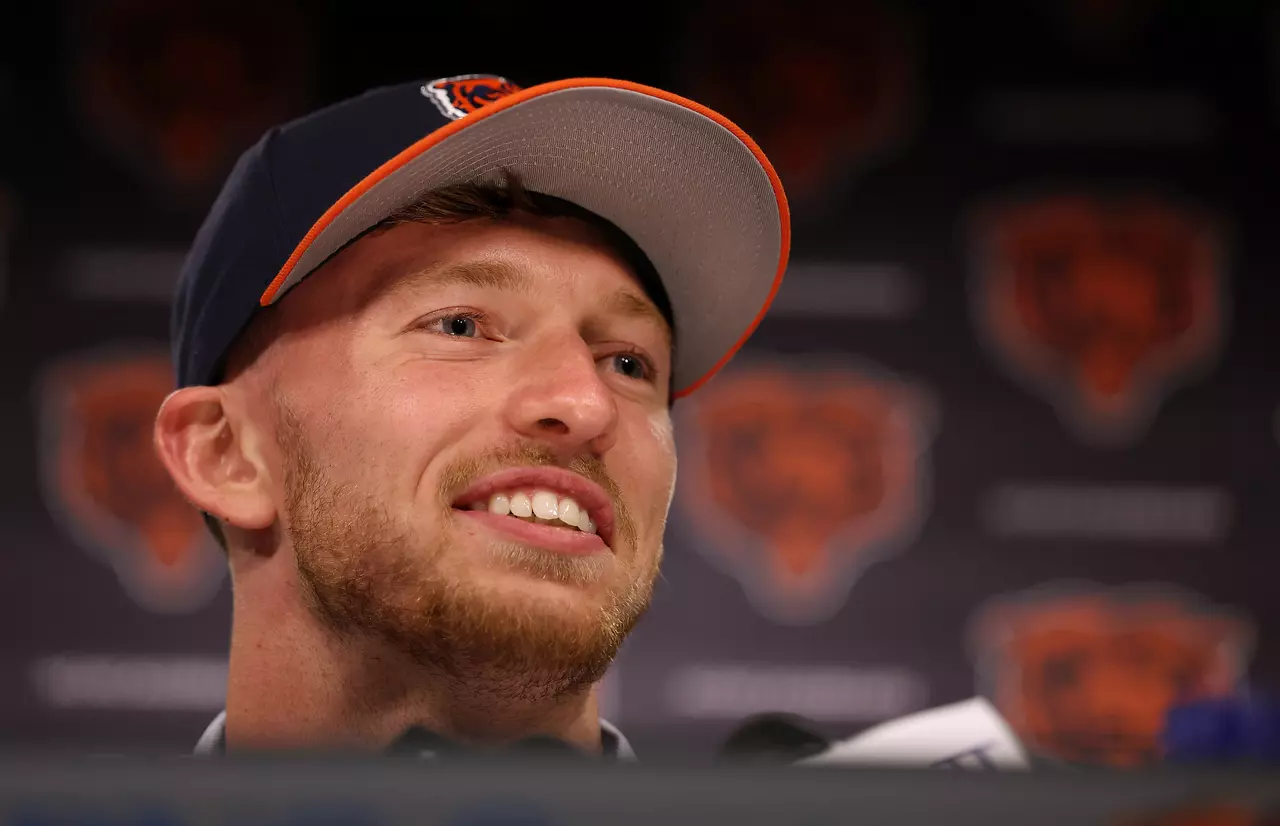
New Chicago Bears safety Dillon Thieneman speaks after being introduced at Halas Hall in Lake Forest, Illinois, on Friday, April 24, 2026.
Chris Sweda/Chicago Tribune/TNS
CHICAGO — As Dillon Thieneman’s high school coach tells it, Thieneman’s father, Ken, had a saying while Dillon was growing up.
“His dad says all the time: You’ve got to skate to where the puck’s going, not to where the puck is,” said Jake Gilbert, Thieneman’s coach at Westfield (Ind.) High School and now head coach at Division III Wabash College in Crawfordsville, Ind.
Ken didn’t invent that saying, as any hockey fan or student of Wayne Gretzky would tell you. Dillon himself admitted he’s a little foggy about that memory.
But the underlying message stuck with him.
“My idea of it is it’s probably more of a feel for the game,” Thieneman said Friday while holding court during his first news conference at Halas Hall. “How’s the pocket moving? What are they trying to attack? And just be aggressive to the point of attack.”
Thieneman applied that philosophy — skate to where the puck is going — while making the most critical decision of his career: relinquishing a family legacy at Purdue, rolling the dice on one visit to Oregon and embracing some uncomfortable truths about himself.
But that foresight — seeing where he needed to be, not where he was — set him on a path to being drafted in the first round by the Chicago Bears.
Oregon defensive coordinator and safeties coach Chris Hampton remembers when Thieneman was in the market for a new college program. Bringing up all the tackles he missed during his sophomore season at Purdue would seem to be the worst recruiting pitch — but not for someone with Thieneman’s makeup.
“He had a bunch of visits lined up. We were the first one,” Hampton said. “We talked about the plan. It wasn’t like an entertainment, like when we take him out and party. It was strictly football and the plan for his development and how we can get him to be a first-round draft pick, and he was all in.
“He wanted to know his weaknesses. It wasn’t just about his strengths. It was what does he need to improve on in order to get called by (an NFL team like) the Bears.”
The Ducks staff made cut-ups, “we watched film of it and he saw it, he knew it,” Hampton said. “And we talked about how we want to improve it and what was the plan in place.”
He was sold. Even with his NFL future on the line, Thieneman “canceled all the other trips,” Hampton said.
Thieneman said Friday that, from past experience, recruiters typically are “just sugarcoating or trying to talk you up.” But Hampton and head coach Dan Lanning “didn’t sugarcoat anything.”
“They told me exactly,” he said, “like: ‘We think you’re a good player. This is what you need to work on. This is how we get you better. This is how we develop guys fast.’ And to see those examples and see how they had it planned for me made it very easy.”
Said Hampton: “Not only did he listen to what I said, he did stuff on his own and he really attacked it.”
Thieneman drilled and drilled some more during his time in Eugene. Even during noncontact drills and walk-throughs, he would get in position — moving exactly where he was supposed to be on the field — and imitate making the tackle.
“It was unbelievable how addicted to the process he was,” Hampton said.
Lessons came early
Thieneman has two older brothers, Brennan and Jacob, who played safety at Purdue as walk-ons. They, along with his parents, helped instill a love for the game.
“It starts with that little kid, the 4-year-old me looking at that TV being like, ‘Hey, it’s going to be me out there,’” Thieneman said. “Then it goes on to see my family and my brothers do it. Seeing my parents, how they work in their businesses, and really watching my brothers out there on the field wanting to be out there with them.”
His family at one point lived in northwest Indiana, in the footprint of Bears fandom.
“I was really young when we were a family of Bears fans, but I’m excited to learn more about the history,” he said. “When we moved down to Indianapolis, we were Colts (fans) but still had the Bears in there somewhere.”
In addition to watching football on TV, Thieneman was watching it play out closer to home through his brothers.
“It definitely helped me,” he said. “They were a good amount of years older than me, so to see what they’re doing, they were teaching it, applying it to me.”
It was a head start on his development.
Go Westfield, young man
While his brothers were shaping how Thieneman should think on the field, physically the game came naturally.
“I coached him all the way back to youth football,” Gilbert said, “and in sixth grade he outran all the kids (at) the fastest, biggest school in the city of Indianapolis. And I kind of took a double take because we never had a player who was fast enough to do that.”
That early work together helped cement a relationship between Gilbert and Thieneman.
The older Thieneman boys played for Guerin Catholic in Noblesville, but Dillon wanted to play for Westfield in the suburb of the same name, north of Indianapolis. Gilbert played him on the varsity as a freshman — in part out of necessity.
“He was itty-bitty and he was wearing a jersey that was way too big and he shouldn’t have (had) to be out there yet, but the moment wasn’t too big for him,” Gilbert said. “And then he made some really big plays along the way. In the state championship game, he forced a fumble, which has kind of been his trademark, creating takeaways.”
Gilbert said Thieneman excelled on special teams. That’s where he began to show anticipation, knowing where the ball would be.
“This guy, if he wasn’t a pro football player, he could do anything,” Gilbert said. “(He had) like a 4.0 GPA, darn near. He is smart. He could be a doctor.”
Thieneman learned a lot from Gilbert.
“Coach Gilbert always used to talked about TNT: the ‘takes no talents,’” he said. “It’s always the effort and attitude. Effort is running to the ball. (It’s) one thing everyone can do, no matter what your talent level is.”
Thieneman tore his MCL before his senior season. The state’s coaches still voted him Indiana’s Mr. Football, “even though that was the only time he’s ever missed any games due to injury,” Gilbert said. “The state of Indiana still respected him that much that he won that award.”
Purdue seemed to be a foregone conclusion because of the family pipeline. Thieneman wasn’t rated as a blue-chip recruit: the No. 85 safety in the nation and No. 990 player overall in the 2023 247Sports composite rankings.
According to Gilbert, “I had one coach of a very, very national program say: ‘Oh, he’s good enough to play for us. I just can’t take him because he doesn’t have enough stars.’”
College career reaches a boiling point
Thieneman never enjoyed much winning football at Purdue, though he had six interceptions — tied for second in the Big Ten — as a freshman in 2023.
But 2024 was abysmal.
The Boilermakers finished 1-11 and winless in the Big Ten, and Thieneman had no picks. That December, Purdue fired coach Ryan Walters.
“It was tough mentally for him,” Gilbert said of Thieneman’s sophomore season. “It was tough physically for him. … I think once the coaching change happened, they were just kind of like, well, maybe we should be more open to something new.
“Turns out, there were a lot of people interested.”
A couple of weeks after Walters’ firing, Thieneman made the call: Instead of returning to West Lafayette, he entered the transfer portal and pushed in his chips with Oregon.
“Going into that year at Oregon, I had the goal set that I wanted to go one year and go (pro),” Thieneman said. “So I wanted to put everything I could into that, knowing that if I did decide to stay, it was the right decision. If I decided to leave, I put everything in.
“So I made the right choice going to Oregon.”
Duck and coverage: A transformative year
The Ducks used Thieneman in a variety of ways, taking advantage of his quarterback-like field instincts and downhill speed. But he was primarily a field safety, a rover, in Oregon’s three-safety system.
“He would play a little bit when we got into ‘umbrella' coverage,” Hampton said. “He was what we call our ‘adjuster.’”
That means he played in the middle of the field, but he could cover the slot, too, and various other responsibilities.
“It’s like what the Bears did with Brian Urlacher — highlighted him,” Hampton said. “We (would) just deepen him up about 4 or 5 yards deeper and kept our safeties deep.”
Thieneman said the role allowed him to play fast and be aggressive against the run.
“A lot of times with the distance, I’m off the line of scrimmage, I’m an extra unblocked defender,” he said. “Then in the pass game, I played that rover role where you’re kind of middle field, so you are what the offense most likely wants to target a lot of times.
“That allowed me a lot more opportunities to get around the ball, get more experience. Just think about what the offense is trying, what they’re showing me in their formations and what they’re trying to protect.”
Hampton and Thieneman agree his biggest moment came on Sept. 27. He intercepted Drew Allar on Penn State’s final possession to secure a 30-24 double-overtime win in front of 111,015 at Beaver Stadium.
“It was the White Out, it was ‘College GameDay,’” Hampton said. “Penn State was ranked in the top five (No. 3). We were ranked (No. 6). We had beat them the season before in the Big Ten championship.”
Hampton said the Ducks “practiced that play a ton” because it was a staple of the Nittany Lions offense, and Thieneman executed the defense perfectly.
“To get the pick and then everything just goes silent,” Thieneman recalled. “I could hear all the Oregon fans and my family yelling up in the stands. That was awesome.”
Next destination unknown
Thieneman said he felt a “lot of positive energy” while meeting with the Bears during the scouting combine in Indianapolis.
“They were asking some background questions, talking through some film and had me get on the whiteboard a little bit,” he said.
But you never know with the NFL draft.
Most mock drafts projected the Minnesota Vikings would snap up Thieneman at No. 18. A natural successor to six-time Pro Bowl safety Harrison Smith? It just made too much sense. But the Vikings chose Florida defensive tackle Caleb Banks instead.
The Bears had a limited pool of must-have prospects if they fell to No. 25, and Thieneman was one of them.
“We talk about the board talking to you,” general manager Ryan Poles said. “He was standing out. He was elevated on the board. We kind of work lateral and see who else is up there, and he was No. 1 on our priority list.”
Thieneman didn’t have control this time, but he moved to the space where he needed to be.
Looking back on it, he said: “I just stayed calm and prayed. I hope I got to the right spot, and I think this was the right spot.
“Through the process, we talked at the combine, they showed their interest. I heard a lot from them through other people, and then it all worked out in the end.”
So what’s to come?
The selection of Thieneman got high grades from several draft pundits.
NFL.com’s Chad Reuter gave it an A: “Thieneman can play as a center fielder, but he’s versatile enough to move into the box as a run defender. It’s a marriage made in football heaven.”
Mel Kiper Jr. said during the ESPN broadcast: “You think about the Bears, where they are with their safeties, they want safeties that can cover. And Dillon Thieneman is the guy. … He played center field. He can play in the box. He’s got range.”
Fellow ESPN analyst Louis Riddick added: “He’s a guy who can play in space because he’s fast, athletic, can make plays on the ball.”
Hampton said Thieneman will bring a “crazy” level of commitment to Halas Hall.
“Probably the hardest worker I’ve ever coached,” he said. “The Bears are going to get a guy that’s going to be a perennial All-Pro, Pro Bowl player. I really believe they did. So they got a steal.”
Gilbert said he always has known Thieneman to be “very locked in, serious, focused.” And then he fell back on another hockey analogy to characterize Thieneman as a competitor.
“If he could skate, he’d probably be good at hockey,” Gilbert said, “because he’s physical but he also has great anticipation of where the puck’s going.
“The reason he’s good at space, he gets the jump and processes information fast. And so he’s closing space while other people are still thinking about it.”
____