Nongshim bets on K-food boom with new export-only ramyun factory
UPI

Nongshim bets on K-food boom with new export-only ramyun factory

Thomas Maresca | November 17, 2026

While K-pop and Korean dramas have captivated eyes and ears around the world, South Korea's ramyun makers such as Nongshim have set their sights on a global takeover of taste buds.

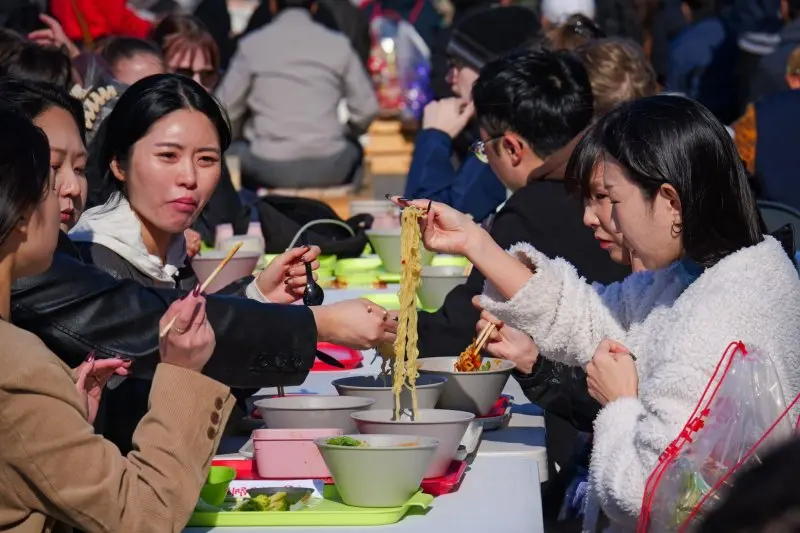
Visitors to the Gumi Ramyun Festival eat bowls of instant noodles on Nov. 6. Photo by Thomas Maresca/UPI UPI Nongshim, Korea's largest ramyun maker, opened a new export-only factory in Busan last month to respond to soaring global demand. Photo by Thomas Maresca/UPI UPI A worker at Nongshim's new Busan factory checks ramyun as it speeds by on a production line. Photo by Thomas Maresca/UPI UPI Nongshim's ramyun products are displayed at the Noksan factory in Busan. Photo by Thomas Maresca/UPI UPI Each high-speed production line at the Noksan plant can produce 600 ramyun packages per minute. Photo by Thomas Maresca/UPI UPI A visitor poses next to a large display of Nongshim's Shin Ramyun cup noodles at the Gumi Ramyun Festival. Photo by Thomas Maresca/UPI UPI The Gumi Ramyun Festival attracted an estimated 400,000 visitors this year. Photo by Thomas Maresca/UPI UPI A visitor poses with a Shin Ramyun mascot at the Gumi festival. Photo by Thomas Maresca/UPI UPI Visitors eat ramyun at the Gumi festival. Photo by Thomas Maresca/UPI UPI Shoppers buy packages of freshly made ramyun at the Gumi Ramyun Festival. Photo by Thomas Maresca/UPI UPI

BUSAN, South Korea, Nov. 16 (UPI) -- While K-pop and Korean dramas have captivated eyes and ears around the world, South Korea's ramyun makers have set their sights on a global takeover of taste buds.

For Nongshim, the country's largest domestic manufacturer of the instant noodles, that means a new $150 million factory in the southeastern port city of Busan dedicated exclusively to exports.

...

On a recent media tour, visitors donned lab coats, hairnets and shoe covers and passed through a hygiene entrance before watching sheets of dough zip along a production line roughly 200 yards long. The dough passed through rollers and was cut into wavy strands, then steamed and portioned before the noodles were fried, cooled and packaged with soup powder and dried toppings at lightning speed.

The factory's high-speed lines can each produce 600 packages a minute, plant manager Jeon Yun-yeol told reporters.

"We are working hard to transform the factory into a global hub for K-ramyun," he said.

The new Noksan plant, which began operating Oct. 29, has three production lines with an annual capacity of 500 million servings, lifting Nongshim's export supply capacity by about 71% to 1.2 billion. The six-story facility has room for eight lines as overseas demand grows.

It brings Nongshim's noodle production network to 10 factories -- six in South Korea and two each in the United States and China -- with combined annual capacity of up to 6.2 billion servings, according to the company.

South Korea's instant noodle exports reached a record $1.52 billion in 2025, up 21.9% from a year earlier, according to the Ministry of Agriculture, Food and Rural Affairs. They rose another 27.9% to $935.4 million in the first half of this year.

Much of the recent global attention was sparked by competitor Samyang Foods' intensely spicy Buldak noodles, which became a social media sensation as consumers filmed themselves taking on "fire noodle challenges."

...

Nongshim, whose Shin Ramyun has long been a staple in Korean households, was slower to recognize the extent of that overseas appetite, said Ji Song-ha, head of its global marketing division.

"To be honest, our initial response to the global market may have been a little slow," she said. "Our products had been loved in Korea for so long that perhaps we were slow to accept that people overseas really liked them."

She credited the broader spread of Korean entertainment with introducing international consumers to the country's food.

"Much of the enthusiasm for K-food has come from K-culture, things like Netflix and K-dramas," Ji said. "We recognize that and are very grateful for it."

Nongshim has leaned into that connection, partnering with Netflix on products featuring characters from KPop Demon Hunters and enlisting K-pop group aespa as global ambassadors for Shin Ramyun last year.

Ramyun fills overseas shelves

Overseas markets accounted for 40.2% of Nongshim's total revenue in the first half of this year. The company aims to increase that share to more than 60% by 2030. Shin Ramyun's international sales rose 36% in the first half, according to the company.

Samyang, meanwhile, generated more than 80% of its third-quarter revenue outside South Korea. It is preparing to open its first foreign factory in Jiaxing, China, and announced plans this month for another production plant in Vietnam.

The expansion is bringing Korean noodles to more mainstream retailers around the world. In Australia, Nongshim products have moved from the Asian section to the regular noodle aisle at Woolworths, Ji said. She also pointed to growing sales through Costco in North America and wider distribution at European supermarket chains.

...

"This was not something we bought. It was a result of consumers' choices," she said of the Woolworths move.

But while Korean culture can encourage consumers to try ramyun, Ji said its lasting appeal depends on what happens after that first bowl.

"I think the first purchase gets a boost from K-culture," she said. "The second and third purchases -- the repeat purchases -- come from taste and quality. More and more consumers are buying it because it is delicious ramyun, rather than because it is Korean food."

Nongshim is broadening its lineup beyond the soup-based noodles associated with the original Shin Ramyun, adding stir-fried varieties and flavors intended to appeal to different markets. Its Shin Ramyun Rosé, introduced this year, combines tomato and cream with Korean gochujang chili paste.

Ji said the company's research suggested consumers were also making noodles into more substantial dishes, adding ingredients and seasonings to suit their tastes.

"Instant noodles used to be seen as a snack between meals," she said. "Now we are finding that they are becoming a meal in their own right."

That experimentation was on display at the Gumi Ramyun Festival, held Nov. 6-8 in a city whose Nongshim factory produces about 75% of the Shin Ramyun made in South Korea.

Nongshim and the city have built a food and tourism attraction around their industrial connection. Launched in 2022, the festival this year turned the streets outside Gumi Station into an outdoor dining hall as an estimated 400,000 visitors sampled creative ramyun dishes from 25 food stalls and eight food trucks.

...

Freshly made noodles from the nearby factory were another draw, with long lines forming to purchase bundles of 25 assorted packs at a pop-up store. Nongshim also produced 200,000 limited-edition packages using Gumi-grown wheat for the event.

New this year was a global recipe competition that brought together 13 culinary influencers from around the world to create original dishes using ramyun.

Lindsey Kathryn, a baker from Seattle, gave hers an American breakfast twist, combining maple-gochujang glazed bacon, a fried egg and melted American cheese with kimchi and ramyun.

Kathryn, 32, said she noticed interest in the noodles surge back home after last year's global phenomenon KPop Demon Hunters, whose animated characters are shown slurping down ramyun.

"KPop Demon Hunters was huge," she told UPI. "[Ramyun] caught on like wildfire. Now you see it all over."

Once regarded as a cheap, quick meal, ramyun has become a source of culinary inspiration, she said.

"Now it's more of an art form, a form of expression with different flavors, creating different mash-ups of cultures," Kathryn said. "So, it's delicious."

Ramyun lovers around the world would seem to agree.

"I don't think there has ever been a time when instant noodles were this popular," Nongshim's Ji said.

Recommended For You.