
Ukrainian probe finds organized Russian use of chemical weapons
A Ukrainian war crimes investigation has concluded that Russian forces used tear gas against Ukrainian troops in a September 2024 attack.
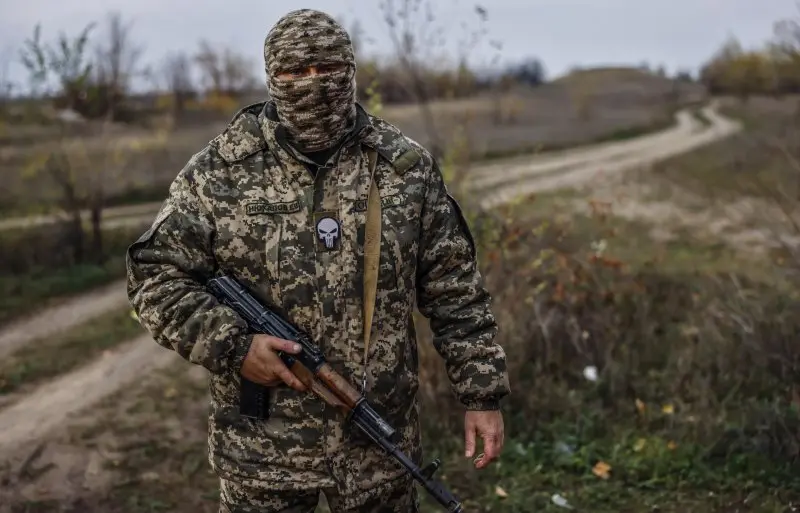
A Ukrainian soldier at a position in the northern Kherson region, November 6, 2022. A Ukrainian criminal investigation report released Tuesday concludes Russia used banned chemical weapons in the war. File Photo by Hannibal Hanschke/EPA-EFE UPI
Nov. 18 (UPI) -- A Ukrainian war crimes investigation has concluded that Russian forces used tear gas against Ukrainian troops in an attack that was part of a broader, organized Russian military practice of deploying chemical agents on the battlefield.
The 76-page report made public Tuesday focuses on accusations that Russia forces tear-gassed Ukrainian troops on Sept. 20, 2024, but also details a systematic program involving the production, procurement of RG-Vo grenades containing 2-Chlorobenzylidenemalonoitrile, also known as CS tear gas, as well as the training of troops in their use.
The investigation team said it found that these grenades are manufactured, procured and supplied to Russian military units trained to use them against Ukrainian personnel manning defensive positions.
"Taken together, the information assessed by the Investigation Team indicates that the use of an RG-Vo grenade containing the riot control agent CS against Ukrainian defensive positions near the village of Illinka on 20 September 2024 was not an isolated or improvised act, but occurred within an organized system involving the manufacture, procurement, military supply and operational employment of such munitions by the AFRF," it said.
The report from the Main Investigation Department of the Security Service of Ukraine, conducted with technical assistance of the Organization for the Prohibition of Chemical Weapons, was undertaken as part of the pre-trial investigation in criminal proceedings initiated on Feb. 6, 2023, investigating alleged war crimes involving the use of prohibited methods of warfare during its invasion of Ukraine.
The allegations stem from the Sept. 20, 2024, attack, during which, according to the report states, a drone launched at about 4:30 p.m. local time from Russia-controlled territory near the Zaporizhzhia nuclear plant dropped an RG-Vo grenade containing CS into a trench at the Zemlya observation post manned by Ukrainian soldiers.
"After falling into the trench line, the RG-Vo grenade functioned and released CS. As the substance dispersed within the trenches, Ukrainian servicemen at the Zemlya observation post were exposed to it and reported the corresponding symptoms described in this report," the investigators said.
An OPCW report published in November 2024 detailing an earlier technical assistance visit states a soldier checked on the location where the grenade landed about 10 minutes earlier and smelled "a pungent odour" as he approached it. He then began experiencing "excessive salivation, and immediately left the trench."
The soldier experienced tearing for about five minutes and nasal congestion for about 20 minutes. When the soldier returned to the shelter, other soldiers could smell the pungent odour on him.
Ukraine says its military has documented 14,009 incidents of Russian forces using chemical agents as a method of warfare in the nearly five-year-old conflict.
Ukrainian Foreign Minister Andrii Sybiha said the report serves as the basis for "concrete international decisions" to ensure Russia is held accountable under the Chemical Weapons Convention, to which Russia is a party.
"We call on the OPCW and its States Parties to establish an effective attribution mechanism and take decisive action against those responsible," he said in a social media statement.
"Russia's systematic violations of the Convention must have direct consequences for its standing within the OPCW."
The OPCW said in a 2024 report that CS had been found in samples taken from the trench, but did not determine responsibility. The report released Tuesday builds on those findings and attributes responsibility to Russia.
The Kremlin has yet to respond to the accusation but has previously denied using chemical weapons in Ukraine, while accusing Ukraine of using chemical weapons against its soldiers.
Several Ukrainian allies criticized Russia following the release of the report, and called on it to abide by the Chemical Weapons Conviction.
"This is a breach of the Convention on Chemical Weapons and Russia must be held accountable. Ukraine can count on Sweden's support," Swedish Foreign Minister Maria Stenergard said in a statement.