
Family of teen killed in NYC horse carriage crash mentions stray voltage in lawsuit filings: report
NEW YORK — The family of a teen killed in a wild June carriage horse crash in Central Park will be filing a $105 million lawsuit against the city — and names stray voltage in the park as a possible cause of the crash, according to a report. Attorneys for Romanch Mahajan’s family have filed a notice of claim — a precursor to the coming lawsuit — and have added Con Edison to their list of ...
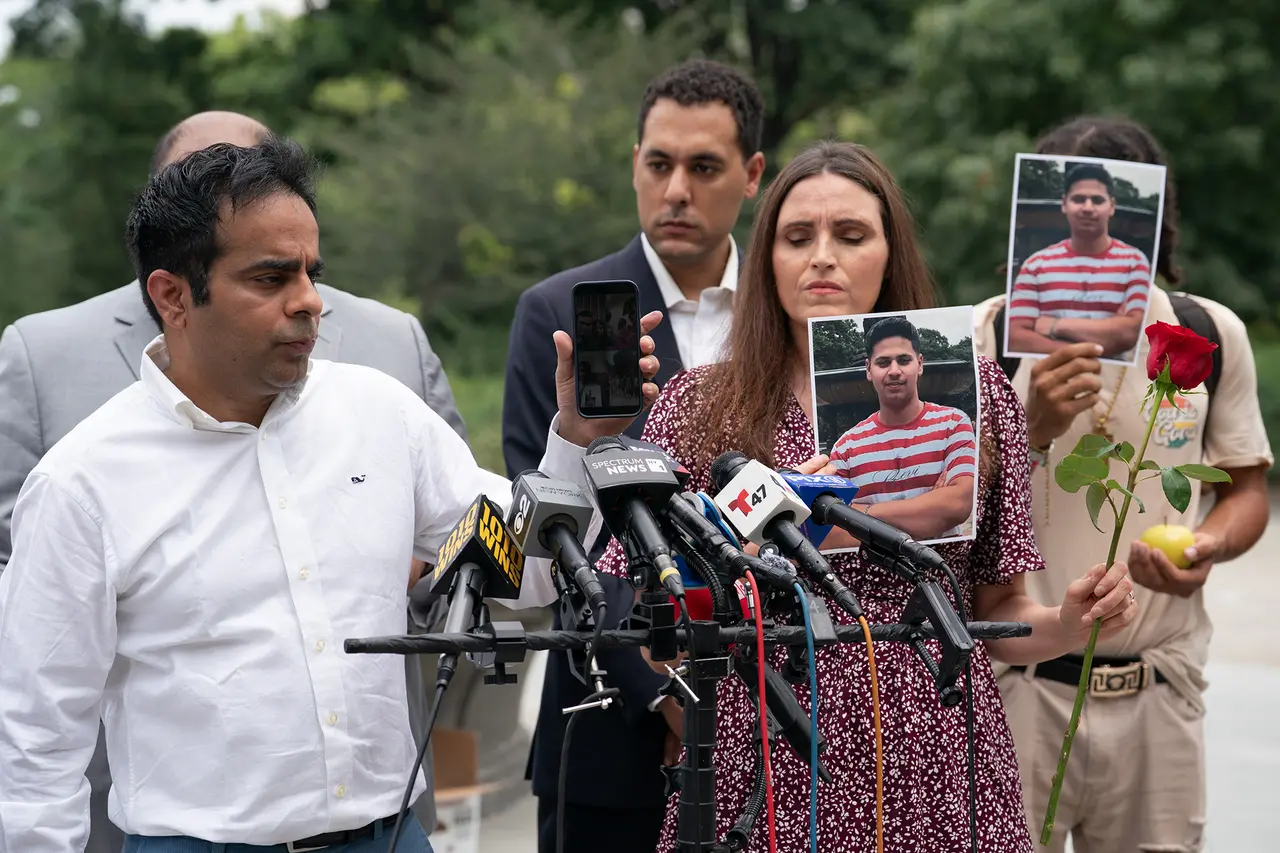
Anuj Thukral, Romanch Mahajan's uncle, holds up a phone with Romanch Mahahan's father, live during a news conference where family members of Romanch Mahajan's family and animal rights activist call for the passage of Ryder's Law, also called Romanch's Law, in Central Park near Cherry Hill on July 27 2026, in New York.
Barry Williams/New York Daily News/TNS
NEW YORK — The family of a teen killed in a wild June carriage horse crash in Central Park will be filing a $105 million lawsuit against the city — and names stray voltage in the park as a possible cause of the crash, according to a report.
Attorneys for Romanch Mahajan’s family have filed a notice of claim — a precursor to the coming lawsuit — and have added Con Edison to their list of defendants, claiming that stray voltage may have “caused, precipitated, contributed to and/or was a substantial factor in” the crash, the New York Times reported Saturday.
City Hall, the Departments of Parks and Recreation, Health and Mental Hygiene, Transportation, and Consumer and Worker Protection are also named in the suit.
The fatal crash has led city leaders and animal rights activists to take a new look at ridding New York of carriage horses. A majority of City Council members — 28 of the 51 — have signed on as co-sponsors to a bill that would end the industry in New York City by 2028.
The bill is currently under environmental review to study its environmental impact, since it will end an entire industry.
The Transport Workers Union, which represents 150 carriage horse workers, said the mention of stray voltage in the upcoming lawsuit is a sign that the carriage horse industry may not be responsible for Mahajan’s death.
“NYC Council Members should now reconsider and reject the proposed carriage-horse ban, which would unfairly punish drivers for faulty city and Central Park Conservancy electrical infrastructure,” the union said on X.
In a statement made last month, union officials said that the discovery of stray voltage in the park “raises serious questions about whether the horse was shocked and whether stray voltage triggered the tragic incident.”
“Now that we know there is a utility failure, it would be horrifically unfair to eliminate the jobs of 200 overwhelmingly immigrant workers without allowing a full investigation to be conducted,” union vice president Alexander Kemp said.
“Stray voltage” is engineering-speak for the naturally occurring, low-voltage charge between two grounded electrical systems. The term is also commonly used as a catch-all for any electricity found where it shouldn’t be.
A ConEd spokesman confirmed to The New York Daily News last month that the utility has detected “stray voltage” in that area of the park in recent weeks, and described the amount of electrical voltage detected as “minimal.”
The horse in question, Samson, bolted from a standstill at Cherry Hill on June 17, after Mahajan and his family, who were visiting from India, had climbed into the carriage after a photo had been taken but before the carriage horse driver was aboard.
As the horse fled, Romanch’s mother was thrown from the carriage. Romanch jumped after her, hitting his head as he tried to help his mother. He died from his injuries in his mother’s arms a short time later.
No direct evidence has been put forth linking Samson’s fatal flight to an electrical jolt.
The city Law Department will review the lawsuit once it’s filed, an agency spokesman said.