
Mike Vorel: Washington should start Elijah Brown at QB vs. Nebraska
SEATTLE — Washington coach Jedd Fisch can be coy about who his starting quarterback will be against Nebraska. After all, it wouldn’t benefit the Huskies to tip their hand, especially considering the Cornhuskers rank ninth in the nation in total defense and 14th in scoring defense. At 4-3, with injuries on the offensive line and in the backfield, Washington would be wise to use every possible ...
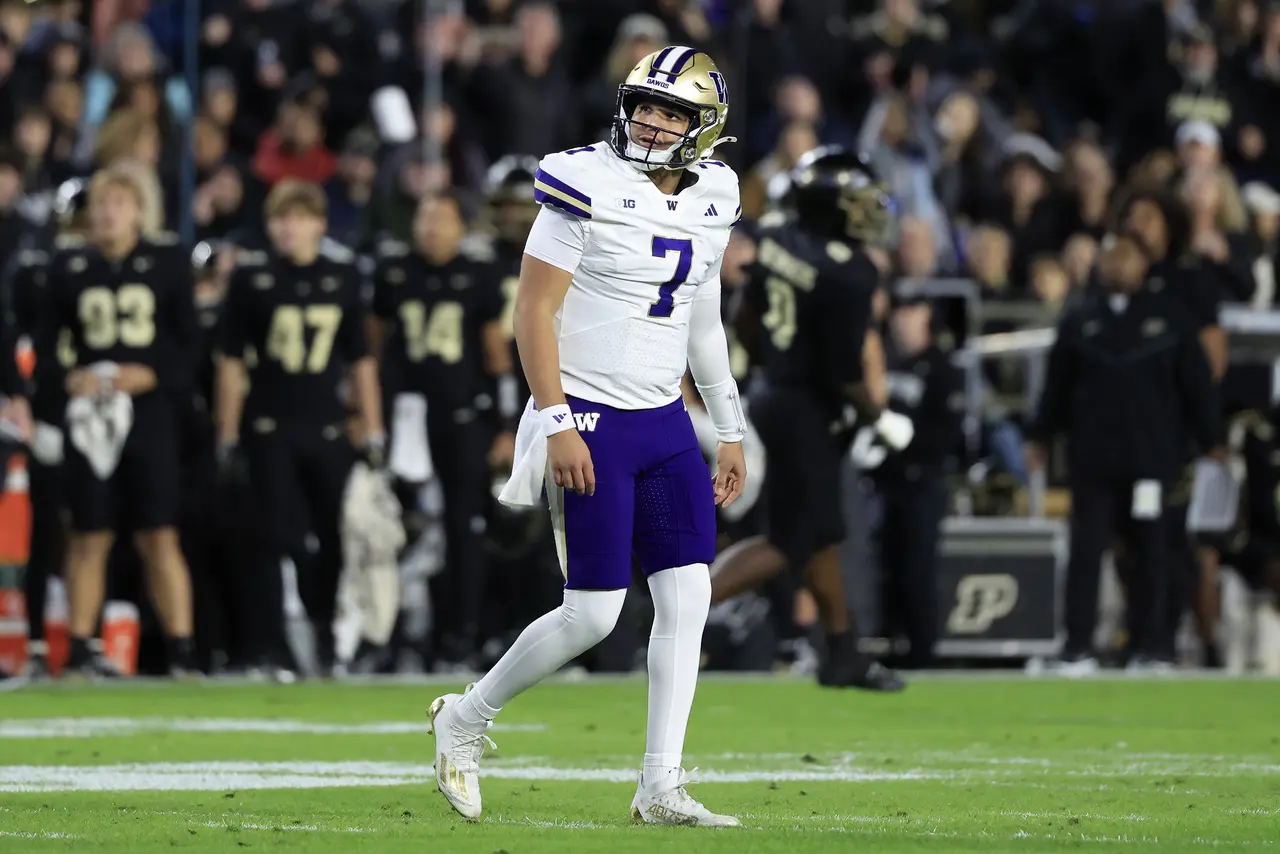
Elijah Brown of the Washington Huskies looks on against the Purdue Boilermakers during the second quarter at Ross-Ade Stadium on Oct. 16, 2026, in West Lafayette, Ind..
Justin Casterline/Getty Images North America/TNS
SEATTLE — Washington coach Jedd Fisch can be coy about who his starting quarterback will be against Nebraska. After all, it wouldn’t benefit the Huskies to tip their hand, especially considering the Cornhuskers rank ninth in the nation in total defense and 14th in scoring defense. At 4-3, with injuries on the offensive line and in the backfield, Washington would be wise to use every possible advantage.
So by all means, keep this secret, a trick held for Halloween.
But come Saturday, Elijah Brown should make his second consecutive start.
That’s despite the reported $4 million NIL contract quarterback Demond Williams Jr. received to return to Washington. It’s despite Fisch’s documented history with Williams, who he recruited as a dual-threat dynamo out of Basha High School in Chandler, Ariz. It’s despite Fisch’s statement during Williams’ freshman season that the opportunity to develop a three-year starter under center is “like a dream of mine.”
Fisch explained: “I think I’ve had 19 (starting) quarterbacks in 20 years. So the idea of having a guy for a couple years that we can build this thing through is pretty exciting.”
Every program is searching for that stability — a steady, reliable, improving standout at your most important position in a dramatically destabilized sport. When NIL and the transfer portal mercilessly remake rosters, every program is searching for a buoy to tie everything else to. Fisch poured time and energy and resources into that dream. He unequivocally committed to it. He had to.
After Williams exploded for 374 yards and four touchdowns (as a freshman) in the 2024 Sun Bowl, Fisch stated plainly that, “We’re going to do everything we can to get him to New York City (for the Heisman Trophy ceremony) one day.”
I don’t blame Fisch for tying his program’s future to one of the most physically impressive college quarterbacks in the country. That’s a slam-dunk decision that countless coaches would have made. For a program lacking the financial firepower to win bidding wars against blueblood bullies, it takes that kind of commitment to keep players here. It’s why Fisch’s plan to relentlessly recruit, develop and retain prep players is more fiscally feasible than an annual transfer-portal plunge. Plus, Husky fans know how significantly a Heisman finalist under center can impact a program.
The problem: Williams is nowhere near a Heisman finalist in 2026. His near exit in January, his concerning struggles this season and his rib injury against Iowa were not part of the plan.
So, it’s time to pivot.
It doesn’t even have to be a permanent pivot. But Fisch needs to know what he has in third-year quarterback and Stanford transfer Brown. After relieving Williams against Iowa, Brown was brilliant, completing 11 of his first 13 passes (including a spike) and throwing for 251 yards and three touchdowns without a turnover. His first UW start was more of a mixed bag, as Brown completed 21 of 27 passes (77.8%) and threw for 302 yards with three touchdowns and three interceptions in a 38-26 win at Purdue.
It wasn’t perfect against Purdue. But with Brown under center, Fisch’s offense has looked more functional and dangerous than it did in six starts with Williams.
So, is Brown — a former four-star recruit and rare four-year starter at prep powerhouse Mater Dei High School in Santa Ana, Calif. — a buoy worth tying your whole team to? Or is he a quality backup capable of spelling Williams (or future four-star freshman Blake Roskopf) for a game or two?
Given that Brown has two more seasons of eligibility, consider this a critical audition.
“I think he’s done a really nice job of being able to, in the six quarters he’s played, really have good control and command of the offense,” Fisch said Monday. “You never know if you’re going to get that or not when you have such minimal reps as a No. 2 quarterback outside of training camp.
“So you don’t really know, how much will he be able to handle when games are going? That last environment was loud, and that last environment was impressive at Purdue. It was a battle. It was a tight game. I was able to see how he could handle some of those challenging situations.”
You can pump in artificial crowd noise throughout practice. You can simulate pressure situations during drills. But there’s no substituting for game experience — or for 85,000 fans at Nebraska’s Memorial Stadium on Saturday.
Besides, Brown’s second consecutive start may also be best for Williams. The 5-foot-11, 190-pounder, who was unavailable against Purdue, is listed as questionable for Saturday’s game. Given that dynamic athleticism is Williams’ wild card, and Washington’s offensive line could struggle without starting center Landen Hatchett, is that really a recipe for success?
“He’s doing much better, but still dealing with … as a quarterback, when you have a fractured rib, you have to be able to not only protect yourself but you also have to be able to have the same velocity and trajectory on the ball,” Fisch said of Williams. “So that’s more of a time thing (to recover from).”
The arrow points one way.
Brown should start against Nebraska (5-2) on Saturday.
Maybe he struggles, and a healthier Williams reassumes the starting role against Penn State on Nov. 7. Maybe Brown succeeds, and a critical audition becomes a revelation.
Either way, Fisch receives more credible evidence of which quarterback is best to build around.
It doesn’t have to be a permanent decision. But it is a prudent one.
____